The Power Grid is Starting to Sense Trouble Before It Starts
CHALLENGES OCTOBER 19, 2026
At A Glance (TL;DR)
The grid is learning to spot problems early. Smart meters, sensors and cameras now stream near real-time data from the "grid edge" (the poles, wires and meters closest to your home), so utilities can catch outages, voltage problems and failing equipment sooner.
It's already widespread: in Itron's 2026 Resourcefulness Report, a survey of 700 utility executives, 96% say they use near real-time edge data to make operational decisions, and 91% call it critical or very important during high-stress grid events.
Wildfire risk is the No. 1 use case. In California, PG&E’s camera network can see more than 90% of its high fire-risk areas, its sensors intercepted 17 potential ignitions in 2025, and this month PG&E and Itron announced a scaled rollout of grid-edge sensors in high fire-risk communities.
The catch: only about a third of utilities have that intelligence fully connected from first detection to final restoration, so there's still room to grow.
For you, it means faster outage alerts, earlier warnings and a grid that's better at fixing small problems before they become big ones.
Most of us only think about the power grid when it fails: the lights flicker, the fridge goes quiet and we start refreshing the outage map. But another shift is underway. The grid is starting to notice trouble on its own, sometimes before anyone on the ground does. Here's how that works and what it means for your home.
The grid has a new sense
For most of its history, the grid was largely blind at the edges. Utilities could see what happened at big power plants and substations, but the last stretch of wire to your house was a black box. Often the first sign of an outage was a customer phone call.
That blind spot matters, because that last stretch is where most trouble happens. More than 90% of customer power interruptions originate in the local distribution system—the lines, transformers, and other equipment that deliver power to homes and businesses, rather than the high-voltage transmission system.
Today those edges are filling up with intelligence. Smart meters, line sensors and connected devices send back a steady stream of near real-time data, and software scans it for anything unusual. A flicker in voltage, a strange current pattern or a meter that suddenly goes silent can all be early clues.
Utilities are leaning in. In Itron's 2026 Resourcefulness Report, a global survey of 700 utility executives:
96% use near real-time data from grid-edge devices (meters, sensors and endpoints) to support operational decisions, and 59% say that edge intelligence is fully operational in driving decisions across their operations.
91% say near real-time intelligence is critical or very important to their response when a high-stress grid event hits.
What "sensing trouble" actually looks like
"The grid is paying attention" sounds abstract, so here's what it means in practice:
Detecting outages automatically. When a smart meter loses power, it can send a final "last gasp" signal. Utilities can then pinpoint where the power is out without waiting for calls, and confirm restoration the same way.
Catching voltage problems. Meters and sensors flag voltage that runs too high or too low, which can damage appliances and signal a failing transformer upstream.
Spotting equipment before it fails. Some sensors listen for the electrical "signatures" of trouble, like arcing, partial discharge or worn insulation, so crews can fix a problem on a calm day instead of during a storm.
Finding downed lines faster. Detection systems can recognize when a line has come down and help locate it, a critical safety step in dry, windy conditions.
PG&E offers a good real-world example. Its grid monitoring center now pulls data from more than 5.5 million sensors, and in 2025 those tools intercepted 17 potential ignitions in high fire-risk areas while avoiding an estimated 12 million minutes of customer outages. Each of those is a problem caught before it could become a fire or a long outage.
And PG&E is adding more. PG&E and Itron recently announced they’re moving from a proof of concept to a scaled pilot of Itron’s grid edge intelligence in high fire-risk communities. About 3,000 devices are going in during the first phase, starting in the Santa Cruz area, with roughly 10,000 planned through 2027. PG&E plans to scale to hundreds of thousands of devices by 2030. The devices capture the electrical “waveform” on a line, talk to each other and analyze the data right where it’s collected. That lets them tell the difference between worn insulation, an overloaded piece of equipment and a failing wire, so crews know what they’re heading out to fix.
Eyes on the horizon: wildfire cameras
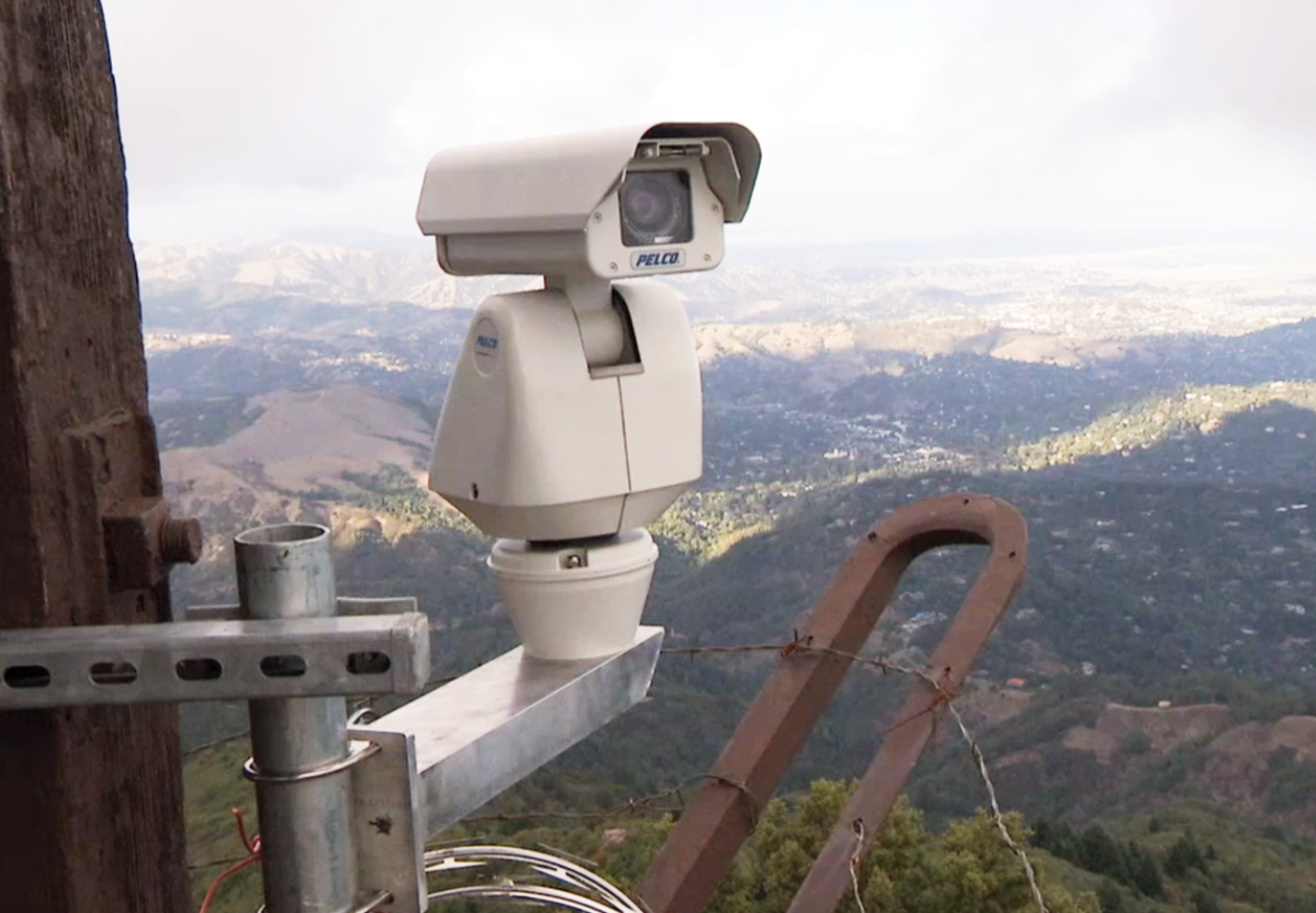
Sensors on the wires are one layer. Cameras on the ridgelines are another.
PG&E has installed hundreds of high-definition cameras across Northern and Central California, with 700+ now in place. By PG&E's own reporting, the network can see more than 90% of its high fire-risk areas. Many of these cameras now use AI to send automated alerts within seconds of detecting smoke or fire, giving firefighters a head start. CAL FIRE, the U.S. Forest Service and the Bureau of Land Management all use the feeds.
Statewide, the results are encouraging. California's ALERTCalifornia camera network, run with UC San Diego, detected 1,668 fires in a single year, 636 of them before anyone called 911. When a fire is small, minutes matter.
Wildfire is where utilities are focusing first
It's no accident that wildfire leads the way. When utility executives in Itron's survey named the areas where they're using near real-time grid-edge data to make decisions, the top four were:
Wildfire and vegetation risk management 34%
Outage detection and restoration 32%
Load and demand management 31%
Fault location and isolation 30%
Wildfire risk, outages and faults are all physical grid events, the kind of problem a well-placed sensor or camera can catch early.
The PG&E–Itron rollout is a good example of that priority in action: it starts in the high fire-risk communities where catching a failing wire early matters most.
The gap that's left to close
Here's the honest part: seeing a problem and fully acting on it aren't the same thing. In the same survey, only 35% of utilities say near real-time intelligence is fully integrated into their response, from detection through restoration. The biggest obstacle they cite is technical integration (53%): systems that don't yet connect and share data automatically.
In other words, the grid's new senses are mostly in place. The next step is wiring them together so an early warning automatically becomes the right action, in the control room and in the field. That's where utilities are heading next: enterprise-wide integration ranks as their top priority for the next three years.
What it means for you
You don't need to install anything to benefit from a smarter grid, but a few simple steps help you make the most of it:
Sign up for your utility's outage and safety alerts. Text or email alerts are often the fastest way to learn about outages, restoration times and planned safety shutoffs during high fire-risk weather.
Bookmark your utility's outage map. As detection improves, maps update faster and more accurately, often before you'd think to call.
See what the cameras see. Many wildfire camera feeds are public. PG&E customers can view cameras and weather stations at pge.com/weather.
Treat every downed line as live. Stay far away, keep others and pets back, and call 911 and your utility right away. Sensors can help locate a downed line, but your report still matters.
Have a basic outage plan. A flashlight, a charged power bank and a plan for medications or medical devices go a long way. (Our September post on El Niño and winter energy has a simple checklist.)
FAQ
How do utilities know my power is out if I don't call?
Many homes now have smart meters that send a final "last gasp" signal when they lose power. Utilities use those signals, along with line sensors, to see where outages are, often within minutes, and to confirm when power is back on.
What is grid-edge data?
It's information collected at the outer edges of the power grid, from smart meters, sensors and other connected devices on the poles, wires and transformers closest to homes and businesses. Analyzed in near real time, it helps utilities spot problems faster and more precisely.
Can the grid really detect wildfire risk before a fire starts?
In many cases, yes. Sensors can pick up the electrical signs of failing equipment, arcing or a downed line, all of which can spark fires in dry conditions, so crews can fix or shut off the problem early. PG&E reports intercepting 17 potential ignitions in high fire-risk areas in 2025 this way. PG&E and Itron are now scaling up sensors that can tell insulation breakdown from a failing conductor, starting in high fire-risk communities near Santa Cruz.
How do AI wildfire cameras work?
High-definition cameras on mountaintops and ridgelines scan the landscape around the clock. AI software analyzes the images for signs of smoke and sends alerts to dispatchers within seconds, so trained staff can confirm the fire and send crews. In California, these cameras have spotted hundreds of fires before the first 911 call.
Do smart meters help prevent outages?
They help shorten and sometimes prevent them. Smart meters can flag voltage problems and signs of failing equipment before a full outage, and when an outage does happen, they help utilities pinpoint the location and restore power faster.
What should I do if I see a downed power line?
Assume it's live and dangerous. Stay far away, keep people and pets back, never touch it or anything it's in contact with, and call 911 and your utility immediately.
Sources & further reading
2026 Itron Resourcefulness Report: Data Analytics & the Intelligent Grid https://www.itron.com/resourcefulness-report
Itron and PG&E Advance Strategic Collaboration to Address Wildfire Mitigation with Grid Edge Intelligence — Itron: https://na.itron.com/w/itron-and-pge-collaborate-to-address-wildfire-mitigation-with-grid-edge-intelligence
How PG&E Is Catching Wildfire Risks Before They Start — PG&E: https://www.pge.com/en/newsroom/currents/safety/how-pg-e-is-catching-wildfire-risks-before-they-start-.html
Wildfire Safety Progress (700+ cameras) — PG&E: https://www.pge.com/en/outages-and-safety/safety/community-wildfire-safety-program/wildfire-safety-progress.html
EPIC Final Report (camera viewshed coverage of 90.81% of High Fire-Threat District areas) — PG&E: https://www.pge.com/assets/pge/docs/about/corporate-responsibility-and-sustainability/pge-epic-project-3.45.pdf
The Science Behind Wildfire Safety (AI alerts within seconds) — PG&E: https://www.pge.com/en/newsroom/currents/safety/the-science-behind-wildfire-safety--pg-e-s-proactive-approach.html
Over 1,000 AI cameras help spot California wildfires before the first 911 call — FireRescue1: https://www.firerescue1.com/artificial-intelligence/over-1-000-ai-cameras-help-spot-calif-wildfires-before-the-first-911-call
Lawrence Berkeley National Laboratory, Distribution System Versus Bulk Power System: Identifying the Source of Electric Service Interruptions in the US.