What Is a Microgrid — and Could You Have One?
CONSERVATION AUGUST 4, 2026
At A Glance (TL;DR)
August is when the grid is pushed hardest — heat waves, wildfire season, and storms all landing at once. With 80% of major U.S. power outages traced back to weather, it’s a good idea to have a backup plan. A microgrid is a small, self-contained power system — usually solar panels, a battery and smart controls — that can disconnect from the larger grid and keep running on its own when everything around it goes dark. True neighborhood-scale microgrids are still rare today, but this idea already works at the scale of a single home, and it’s proving itself when the power goes down. Here’s what a microgrid is, what you can do about your own home before the next outage, and where this is all heading.
August Is the Hardest Month for the Grid
Heat waves, wildfire season, late-summer storms, record air-conditioning demand — August tends to stack all of them on top of each other. Power matters most at exactly the moment the system is under the most strain.
And it’s not your imagination that outages feel worse than they used to. According to Climate Central, 80% of major U.S. power outages are caused by weather — and they’ve roughly doubled over the past decade. The grid we’re leaning on harder every summer is also the grid that’s most exposed to the weather that’s knocking it out.
So the question stops being if the power goes out and becomes what’s my plan when it does.
The Backup Plan You Already Know
For most of us, the answer has always been the gas generator. And it works — sort of. It’s also loud, it runs on fuel you have to store or go find, it powers one house at a time, and it’s close to useless in exactly the scenario you bought it for: a regional outage where the gas stations are dark too and the roads are blocked.
The generator isn’t wrong. It’s just the old version of the idea. Here’s the upgrade.
The Upgrade: What a Home Microgrid Is
Strip a microgrid down to its parts and it’s three things: a source of power (usually solar panels), a place to store it (a battery), and a brain (controls that decide what to do with it).
The concept is islanding. When the grid goes down, a microgrid disconnects — it forms its own little “island” of power and keeps running on its own, drawing from the battery and the sun instead of the dead wires overhead. The lights in that one lit-up house on a dark street? That’s islanding.
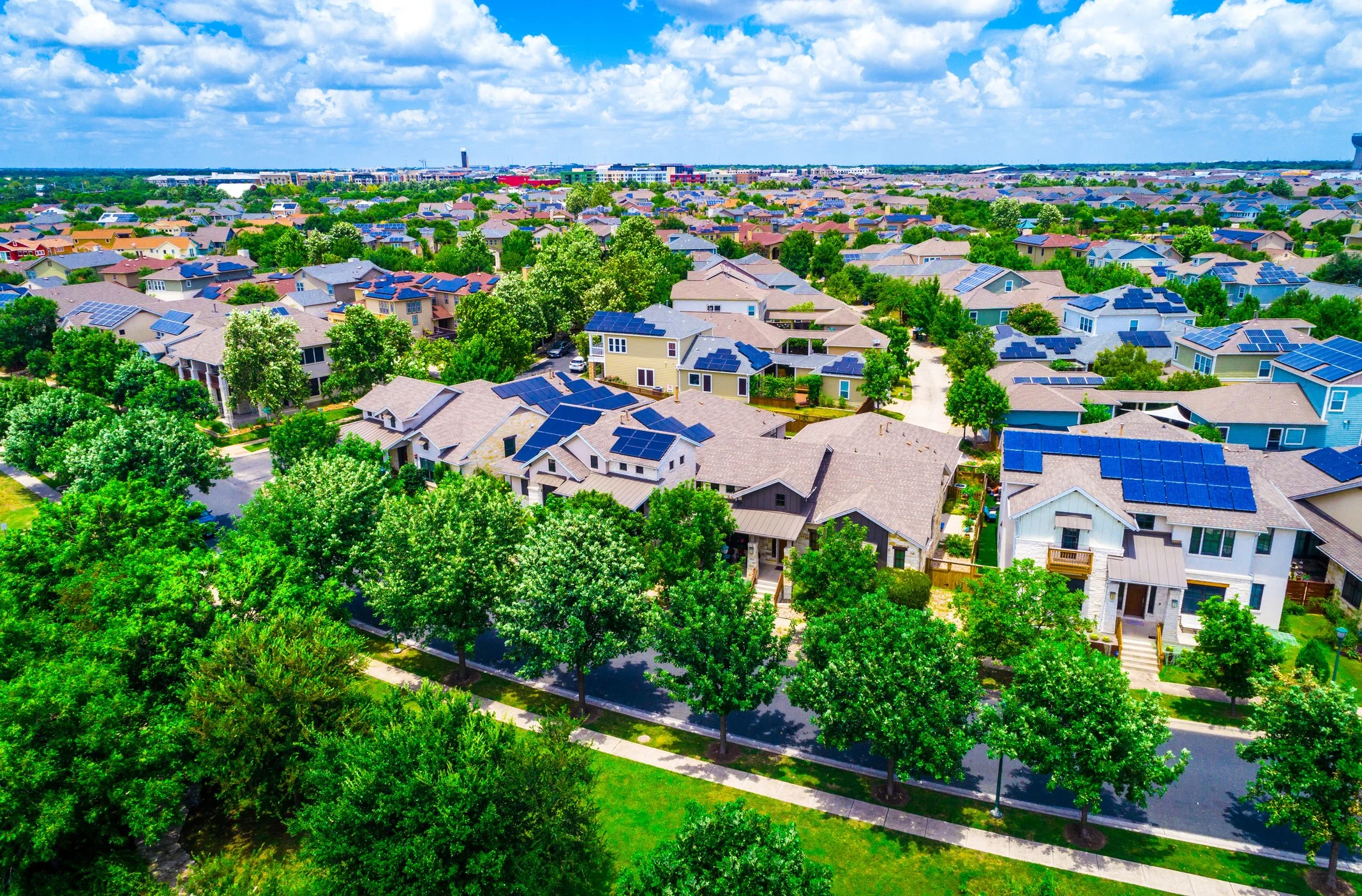
Here’s the part most people miss: a home solar-and-battery setup that can island is already a microgrid — just the smallest possible one. Learn the idea here, at the scale of a single house, and the neighborhood version later in this post is the exact same thing, only bigger.
What You Can Do Today
This isn’t a story that only works if you can write a five-figure check. There’s a rung on this ladder for almost everyone — including renters.
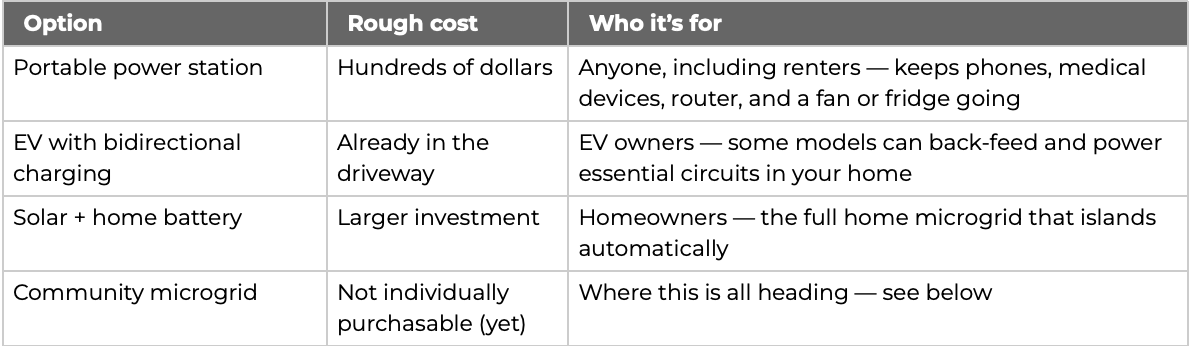
A couple of things worth doing no matter which rung you’re on:
Know your outage plan before the August peaks. What has to stay powered — a medical device, insulin in the fridge, a sump pump, a way to charge phones? Size your backup to that, not to the whole house.
Ask your utility or city what local resilience projects exist. Many are further along than residents realize.
On cost and incentives: Some state incentives for home solar panels and storage exist, but they change often — so check what’s active in your state right now before you buy.
Now Scale It Up: The Community Microgrid
Take that exact home setup — solar, batteries, smart controls, the ability to island — and grow it to serve a whole cluster of buildings instead of one. That’s a community microgrid: a shared power system that can disconnect from the regional grid and keep an entire neighborhood, campus, or downtown block running on its own.
Because you already understand the mechanism from your own home, this lands as something concrete rather than abstract. It’s not a different technology. It’s the same island, drawn bigger.
Where Microgrids are Already in Place
Community microgrids aren’t a someday idea — they already exist, concentrated where the stakes are highest:
Wildfire country. When utilities cut power to whole regions to keep their lines from sparking fires (a “Public Safety Power Shutoff”), microgrids keep the fire station, the clinic, and the grocery store lit while the grid around them is intentionally dark. For anyone in Oregon who’s lived through a PSPS, this one’s not theoretical.
Hurricane zones. After Hurricane Maria, solar-and-battery microgrids kept power on in parts of Puerto Rico while the main grid was down for months. Gulf and Florida “resilience hubs” now do the same during storm season.
Extreme heat and flooding. Cooling centers and neighborhood resilience hubs stay powered at peak demand — exactly when a heat wave makes losing power dangerous instead of just inconvenient.
Today, several hundred microgrids already operate across the United States — the U.S. Department of Energy’s tracking database logs them by the hundreds — and their combined capacity has been climbing at double-digit rates for years. The right way to read that isn’t “so I can’t have one” — it’s that microgrids show up first where losing power is most costly, and they’re spreading outward from there. (Exact counts vary by how you define a microgrid; the direction doesn’t.)
Where It’s Heading
The direction is clear. The U.S. microgrid market is growing at roughly 19% a year, on track to quadruple by the mid-2030s — from about $28.6 billion in 2025 to roughly $136 billion by 2034, according to Market Data Forecast.
Part of what’s making community-scale microgrids practical is that the grid itself is getting smarter at the edges. Utilities are increasingly pushing intelligence out to the meters, panels, and transformers in your neighborhood — so power can be sensed, shifted, and islanded automatically instead of by a technician flipping switches. (Itron, for example, builds this kind of distributed intelligence into the grid edge.) That’s the groundwork that turns a street full of individual home batteries into something that can act together.
You can watch this happen in real time. In June 2026, North Carolina began rolling out a network of up to two dozen microgrids across six mountain counties still recovering from Hurricane Helene — communities that lost power and communications for weeks after the storm. Paired with mobile solar-and-battery units, they’re being set up as “resilience hubs” at food banks, libraries, and fire stations: places that can keep refrigeration for food and medicine, device charging, and water filtration running the next time the grid goes dark.
Your Questions, Answered
Can a home battery power my house during an outage?
Yes — if it’s set up to island. A home battery paired with the right transfer equipment disconnects from the grid when the power fails and runs your home’s circuits off stored energy. How long it lasts depends on the battery’s size and how much you’re running; sizing it to your essentials (fridge, medical devices, lights, internet) stretches it much further than trying to power everything.
Home battery vs. generator — which is better?
They solve the problem differently. A generator makes power on demand but needs fuel, runs loud, and does nothing until you start it. A home battery is silent, starts automatically the instant the grid drops, needs no fuel deliveries, and — if paired with solar — refills itself from the sun. A generator can run indefinitely as long as you have fuel; a battery is limited by its charge. Many people who want days-long resilience end up with both; most who want seamless, hands-off backup lean battery.
What is islanding?
Islanding is when a power system disconnects from the larger grid and keeps running on its own — forming a self-sufficient “island” of electricity. It’s the core trick that separates a true microgrid from a simple solar array, and it’s what keeps your lights on when the grid goes down.
Can I get a microgrid for my home?
Yes — a home solar-and-battery system that can island is a residential microgrid, and it’s available today. Full neighborhood-scale microgrids generally aren’t something an individual buys, but the home version is real, purchasable, and increasingly common.
Are home batteries worth it?
It depends on why you’re buying. If you face frequent or dangerous outages, the value is resilience you can’t easily put a price on. If you also have solar and time-of-use rates, a battery can shave costs by storing cheap or self-generated power for expensive hours. Incentives can improve the math, but they change often — check what’s currently offered in your state before deciding.
What is a microgrid in simple terms?
A microgrid is a small, local power system — a source of electricity, a battery to store it, and controls to manage it — that can either work with the main grid or disconnect and run entirely on its own.
How is a microgrid different from a generator?
A generator only makes power when it’s running on fuel. A microgrid generates, stores, and manages power continuously, can run on renewable energy, and switches to running independently the moment the grid fails — silently and automatically.
Do microgrids work during a power outage?
Yes — that’s the whole point. Through islanding, a microgrid keeps supplying power to the homes or buildings it serves even when the surrounding grid is completely down.
Can a microgrid power a whole neighborhood?
Yes. A community microgrid can serve a cluster of homes, a campus, or a downtown district, keeping essential services running when the regional grid fails. These are less common than home systems today but are growing quickly.
What is a resilience hub?
A resilience hub is a community building — often a library, community center, or school — equipped to stay powered (frequently by a microgrid) so residents have a safe, cool, charged place to go during an outage, heat wave, or disaster.
How have microgrids performed during recent wildfires and hurricanes?
Well enough that they’re no longer experimental. During wildfire-driven power shutoffs, microgrids have kept critical facilities running; after major hurricanes like Maria, solar-and-battery microgrids kept the lights on for months while the main grid was being rebuilt.
What is a smart community?
A smart community uses connected technology — smart meters, sensors, distributed energy, and microgrids — to manage resources like power and water more efficiently and to bounce back faster when something goes wrong. A neighborhood of coordinated home batteries and a shared microgrid is a smart community keeping its own lights on.
The Bigger Picture
Every August, the grid is asked to do a little more than the August before — more heat, more demand, more weather hitting the same wires. Microgrids are one of the clearest answers we have, and the encouraging part is where they start: not with a massive public project, but with a single home deciding to keep its own lights on. Scale that up, house by house and block by block, and you get neighborhoods that can look after themselves when the grid can’t.
That shift is already picking up momentum from an unlikely direction — older Americans. Author and climate organizer Bill McKibben, through his group Third Act, is mobilizing people over 60 to push for exactly this kind of clean, resilient, community-scale power — arguing that the generation with the most political and financial weight can move it fastest. It’s a good reminder that a microgrid isn’t only hardware. It’s a choice a household, and then a community, decides to make.
You don’t have to wait for the grid to fail to find out what your plan is. Start with the rung you can reach — a power station, an EV that can back-feed, a home battery — and know that you’re standing at the small end of something that’s growing toward whole neighborhoods.
Sources:
Weather-caused outages (80% / doubled) — Climate Central: climatecentral.org
U.S. Microgrid Market ($28.6B → $135.7B, 18.9% CAGR) — Market Data Forecast: marketdataforecast.com
Microgrid Market Size — Fortune Business Insights: fortunebusinessinsights.com
U.S. Microgrid count and capacity — U.S. Department of Energy (Microgrid Installation Database): energy.gov
U.S. microgrid market growth ~19%/yr — Wood Mackenzie via Utility Dive: utilitydive.com
2026 deployment — N.C. post-Helene microgrid / resilience-hub initiative — NC DEQ: deq.nc.gov
Third Act (Bill McKibben): thirdact.org
Grid-edge distributed intelligence — Itron: na.itron.com